How it works
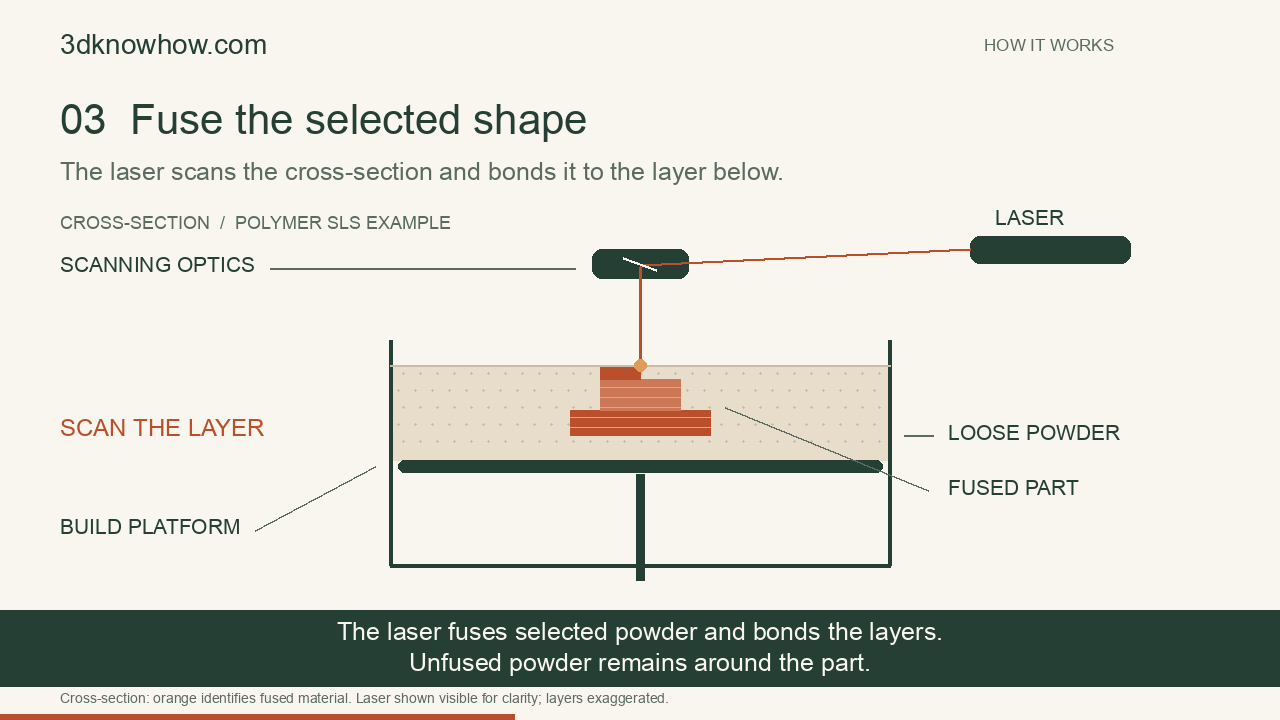
SLS uses a laser to fuse selected areas of polymer powder. Other powder-bed approaches use applied agents and thermal energy. Surrounding powder supports many features during the build.
Watch polymer powder printing in action
This 92-second animation follows polymer SLS: preparing the build, spreading and preheating powder, laser scanning, adding layers, cooling, and removing loose powder. It also compares SLS with agent-based Multi Jet Fusion. Motion, geometry, and layer height are simplified for clarity.
Select the preview to watch. On iPhone and iPad, it opens in the native player; use Back to return to this guide.
Materials you can use
Nylon is a familiar example, but each system supports particular powder formulations and processing conditions. Filament and powder are not interchangeable.
Where it shines
Useful for interlocking forms, complex channels, and batches of functional components. Parts still need unpacking, depowdering, and sometimes surface finishing.
Plan the whole workflow
Plan how powder can be removed from cavities. Powder management, equipment, and workspace requirements are an important part of the workflow. A print service is one way to access this process.
A real machine to explore
Formlabs Fuse 1+ 30W is an example of this printing family. It illustrates the process; this is not a hands-on review or a buying ranking.
Keep exploring
Sources & further reading
Manufacturer process documentation, SLS process guide, and HP Multi Jet Fusion process documentation. Product links checked October 31, 2026.